Why Your Pest Control Leads Stop at the Map Pack Border
Why Your Pest Control Leads Stop at the Map Pack Border: A Masterclass in Google Business Profile SEO
You’ve seen it before. You’re sitting in your office, you pull out your phone, and search for “pest control near me.” There you are – Number 1. You feel like the king of the mountain. But then you drive three miles down the road to a job site in the next suburb, search again, and you’ve vanished. It’s as if an invisible wall exists at the city limits, and your google business profile seo is powerless to climb over it.
This is what I call the “Map Pack Border.” For most pest control owners, this border is a death sentence for lead generation. According to research from Incline Marketing, the top 3 local listings capture the vast majority of urgent pest control calls. If you aren’t in that golden trio, you effectively don’t exist for the homeowner dealing with a midnight cockroach infestation or a termite swarm. This isn’t just about “tips”; it’s about the engineering of your local presence. If you want to scale, you have to stop thinking about rankings and start thinking about geographic infrastructure. Most contractors fail because they miss the foundational elements. You can see the full list in my guide on 7 Checklist Items Contractors Miss That Kill Local Lead Generation.
The Proximity Myth: Why Your Rankings Are Tethered to Your Desk
The “Proximity Myth” is the belief that Google only shows the closest businesses to the searcher. While proximity is a massive factor, it is not an absolute law. It is a “stress test” for your business’s authority. In the world of local seo for pest control, proximity acts as a filter that gets tighter during peak demand periods. Research by Nahid Hasan Shamim suggests that during seasonal surges, Google’s algorithm leans heavily on proximity to provide the quickest solution to the user, but businesses with high prominence can “break” that radius.
When you only rank within a few blocks of your office, it’s because your relevance and prominence signals aren’t strong enough to overcome the proximity bias. You are essentially a “hyper-local” entity rather than a regional authority. To break this tether, you need a professional google maps ranking service that focuses on signal density rather than just basic citations. If you find yourself wondering Why Your Business Only Shows Up on Maps When Customers Are Standing Next Door, you are likely failing the prominence stress test. You have the proximity, but you lack the “gravity” to pull in leads from the surrounding five to ten miles.
The Heat Map Audit: Visualizing Your Geographic Failure
You cannot fix what you cannot see. Standard SEO reports that show “Average Position: 2.4” are lying to you. They are averaging your #1 ranking at your office with your #20 ranking five miles away. To truly understand your market share, you need to use a grid-based heat map. This is the ultimate google maps rank tracker and diagnostic tool.
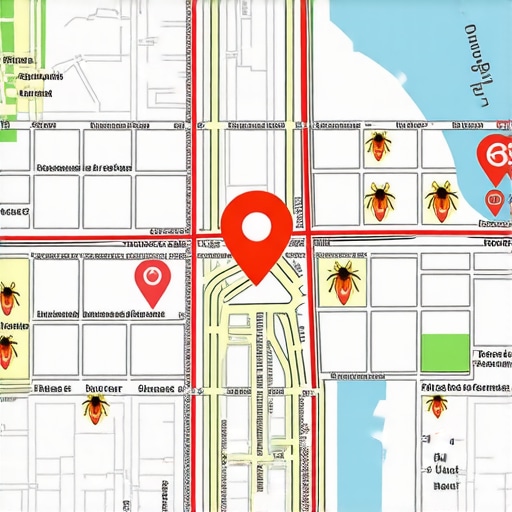
A heat map places a grid over your service area and runs a search from every node. When you see a sea of green (rankings 1-3) in the center, surrounded by a wall of red (rankings 10+), you are looking at your “ranking border.” This visual data point is crucial. As Incline Marketing points out, baseline visibility assessments using heat maps are the only way to set an initial scorecard that reflects reality. Without this, you’re just guessing. Using a google business profile audit tool allows you to see exactly where your signals are failing. If the red nodes start exactly at the county line, you have a geo-relevance problem. If they start at a major highway, you have a physical barrier problem that the algorithm is mirroring.
Breaking the Border: Signal Engineering for Pest Control
To rank higher on google maps in distant suburbs, you must engineer signals that prove you are active and relevant in those specific areas. This goes beyond creating thin “city pages” that no one reads. Google’s algorithm is smarter than that. It looks for “Real-World Attribution.”
- Hyper-local Content: Stop writing generic blogs about “How to Kill Ants.” Write about “The 3 Most Common Ants Found in [Specific Neighborhood].” Mention local landmarks, parks, and even specific soil types that contribute to pest problems in that area.
- Service Area Pages (SABs): If you are a Service Area Business, you must be careful. If you don’t have a physical storefront where customers visit, you must hide your address to avoid suspension, but you must define your service area with surgical precision. There is a specific framework for this; check out The Exact Fix for Service Area Pages That Refuse to Rank on Maps.
- Geo-signals and DataPins: Use tools that allow your technicians to “pin” their location and upload a photo of the job (with the customer’s permission) directly to your site. This creates a live feed of geo-located activity that tells Google, “We aren’t just an office in the city; we are active in the suburbs every single day.”
Leveraging local seo automation tools can help streamline the process of pushing these geo-signals to your profile, ensuring that your google maps lead generation doesn’t stop at the city limits.
Advanced 2026 Tactics: Proximity Mesh & AI Discovery
The future of google business profile seo is moving toward what I call the “Proximity Mesh.” By 2026, Google’s algorithm updates will prioritize “Interaction Depth.” It’s no longer just about the click; it’s about what happens after. Google is increasingly using multi-modal search – where a user takes a photo of a bug on their patio and asks, “What is this and who can kill it?”
In this AI-driven discovery environment, your profile needs to be more than a digital business card. It needs to be a data-rich node in a mesh of local information. This includes “Real-World Attribution” – Google tracking the anonymized location data of users to see if they actually visit your office or if your service trucks are frequently seen in the areas you claim to serve. This is a massive shift in how to improve google maps ranking results. You need to Stop Ignoring Proximity Mesh: 4 Map Ranking Fixes for 2026 if you want to stay ahead of the curve. The companies that win will be those that integrate their physical operations with their digital signals. Utilizing a high-end improve google maps rankings strategy now will position you as the dominant authority before these updates become the standard.
The Review Sentiment Trap: Moving the Map Pin with Words
Reviews are the lifeblood of local map pack seo, but most pest control companies fall into the “Sentiment Trap.” They chase volume – getting 500 five-star reviews that all say “Great service!” Generic reviews are nearly worthless for expanding your ranking radius. To move your map pin into a new territory, you need “Hyper-Local Sentiment.”
When a customer in [Suburb A] leaves a review, you want them to mention the suburb name and the specific pest. “Kevin’s team handled our termite problem in [Suburb A] perfectly.” When you respond, you should reinforce this: “We love helping homeowners in [Suburb A] keep their properties termite-free!” This creates a keyword-location association that Google’s NLP (Natural Language Processing) picks up. This is a subtle but powerful way to rank google business profile higher in specific pockets of your city. For a deeper dive into this tactic, read The Review Sentiment Trap: How Specific Words in Responses Actually Move Your Map Pin.
Conclusion: The Border is a Choice
The “Map Pack Border” isn’t a permanent fixture of the Google algorithm; it’s a reflection of the limits of your current SEO infrastructure. If you are content with only serving the three-mile radius around your office, keep doing what you’re doing. But if you want to dominate the entire metro area, you have to engineer your way out. Perform a heat map audit, optimize your service area pages for real-world activity, and start building a Proximity Mesh that AI search engines can’t ignore. The leads are there – you just have to build the bridge to reach them.